
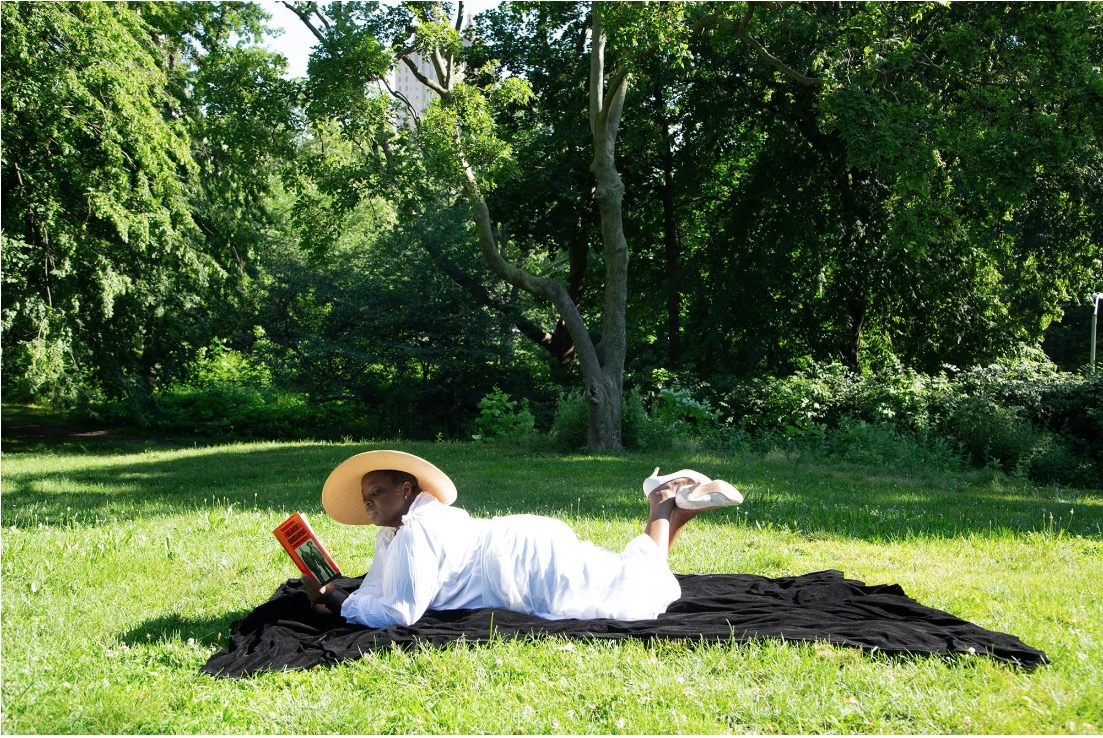
In art history, “nudes” almost always meant nude women, painted by men. An MFA exhibit documents a contemporary rebuttal.
“Subvert, Repair, Reclaim: Contemporary Artists Take Back the Nude” raises important questions — and allows for unsatisfactory answers.
In “Subvert, Repair, Reclaim: Contemporary Artists Take Back the Nude,” just opened at the Museum of Fine Arts, the implied question — take back from whom? — has its answer built in: In art history, “nude” almost always means “nude woman.” The data to back that up is within easy reach: In 1989, the Guerilla Girls, a feminist art collective, conducted a survey at New York’s Metropolitan Museum of Art that found that just 5% of its collection was by women, while 85% of its nudes were of women. A do-over in 2012, the most recent reprise, found that little had changed.
Even with the significant cultural shifts of the past decade, I don’t expect much more than incremental movement then to now. Collections are slow-moving things. They add, but rarely subtract, and I’ve never met a museum that wouldn’t leap at a Botticelli, Titian, or Rubens in all their fleshy, objectifying resplendence, were such things on offer. So the remedy, if there is one, is to keep asking why and how we ended up here, knowing unsatisfactory answers are part of the point.
The MFA itself posed its own challenge to the age old-convention of the nude in uncharacteristically forceful fashion a few weeks back, when Xandra Ibarra paraded naked through its European galleries — during opening hours, no less — laughing hysterically while dragging a blonde wig, pearls, and a fur coat along behind her in a length of stretched out pantyhose. (Don’t worry if you missed it; it lives forever online.) Ibarra is one of the dozen artists included in the new show, a fact you can’t miss from any point, anywhere, in its capacious galleries; a video of the performance plays on repeat and at high volume, her shrieks of laughter echoing loudly from one end to the next. (She’s staged the piece, “Nude Laughing,” many times since its 2014 debut at San Francisco’s ).
That the show is clamorous, unruly, and at times a little squirm-inducing is very much the point. The mostly unquestioning reverence that nudes have commanded over the ages is what’s being disrupted here, and the gallery space of prestigious museums — which, historically, have wrapped centuries of lascivious fantasy in a thin veil of classical philosophy and high cultural erudition — are the appropriate battleground.
The exhibition includes at its outset a baseline marker, and an emblematic stimulus for its response. Very near to the screen from which Ibarra’s wailing emanates, “Moorish Bath,” an 1870 painting by Jean-Léon Gerôme from the MFA’s collection, hangs in a gilded frame. In it, a pale-skinned red-haired woman turns her naked back to the viewer, while her Black attendant prepares her bathing water, faces us bare-breasted. Racial hierarchy sits in the foreground, while the obvious is taken for granted; the image is the conception of a male artist, for an audience of patrons who were almost entirely wealthy men.
This is, of course, nothing new. As feminism gained momentum in the 1970s, a generation of woman saw art as the front line of the equal-rights culture war. “Why Have There Been No Great Women Artists?” was the title of the great art historian Linda Nochlin’s seminal 1971 essay, which answered its own question with an analysis that showed everything from education to exhibition to simply being permitted to make art were privileges denied women for centuries.
In her 2023 book “Art Monsters,” the critic Lauren Elkin delves into some of the more visceral work of that fractious era. In 1972, Suzanne Lacy’s “Ablutions,” which she conceived with artists Judy Chicago, Sandra Orgel, and Aviva Rahmani, invited an audience to sit in a dark room and listen to anonymous women describe their experience of being raped; around the same time, Betty Tompkins began her “Fuck Paintings” series, an explicit rejection of the enduring male fantasy in art of naive, demure nudes positioned as though trinkets for sale. For the series, she painted large-scale photorealistic images of female genitalia in extreme close up.
Tompkins is among the 12 artists here, an eminence grise of blunt, plaintive feminist expression. If you’re wondering: No. The MFA may have pushed its boundaries with the Ibarra performance, but that endeavor of Tompkins remains a bridge too far for most. But she’s an important historical touchstone for a mission that seems unlikely to ever resolve. In her recent “Women Words Painting” series, seen here, she crowdsourced misogynist quips and then hand-painted them word for word over the female figures in iconic paintings; a photograph of Masaccio’s “Expulsion from the Garden of Eden,” 1425, has Eve obliterated in a fury of pink scrawl as Adam laments the loss of paradise. Even a heathen would know that, in the Bible, it was all Eve’s fault. Some of the scrawled pink text reads “A woman’s place is in the home.”
The show, meanwhile, is also about a generational shift and the evolution of resistance. Shock is less the mission of the artists here than recovery — of dignity, of respect, of agency. A pair of rough wooden sculptures by Cato Ouyang reprise the paintings of Balthus, a 20th century painter best-known for his nudes of adolescent girls. He painted his most famous model, the teenaged Thèrese Blanchard, in the 1930s. In her “reliquary corpus” series, Ouyang extracts Blanchard from his frame and rebuilds her in rough wood sculpture, a gesture of protective care. Ouyang excises her identity by leaving the pieces headless, as though a neutralized classical study; she also builds within them tiny shrines as symbols of an inner life that the painter’s objectifying gaze ignored.
Ouyang’s fellow travelers here are many. Rachelle Anayansi Mozman Solano’s ongoing project scrutinizes the work of Paul Gauguin, who infamously took multiple adolescent wives in tribal communities in the South Pacific, and painted young Indigneous girls as an exoticized fantasy of sexual purity. Ouyang’svideo here, “Opaque Mirror,” 2017, using text taken from Gauguin’s letters as dialogue, is a brilliant soft satire of a man straining to mask lechery with cultural fascination.
Mary Enoch Elizabeth Baxter revives the ghastly story of Thomas Eakins, one of the United States’s most celebrated painters, who in the 1880s photographed a young Black girl naked in various poses in his Philadephia studio. Baxter has been working since 2019 to excise the photos from the internet (no small task, though the Pennsylvania Academy of the Fine Arts, a major repository of Eakins’s work, no longer allows the pictures to be seen online). Here, she offers “Consecration to Mary,” a set of daguerrotype portraits in small velvet-lined cases, a symbolic gesture meant to restore dignity and safety to the forgotten girl.
Undoing, surely, is a theme here. Maya Jeffries’s “Silhouettes Remain,” 2022, is a video piece where the artist dissolves nude female figures from an array of famous masterworks — an act of liberation. Her do-over of the Gerôme painting hangs nearby, both women gone in a hollowed-out digital echo of the artist’s objectifying gaze.
But with the very real echo of Ibarra’s hysteria still ringing clear, rooms away, I was left to wonder what was more shocking: An unruly naked woman howling her way through an art museum, or the pronounced void of circumspection we’ve been conditioned to have, where so many canonized Old Master paintings have a naked woman at their center? On that point, the clarifying work of Nona Faustine struck me as elegantly profound.
Faustine’s “White Shoes” series, begun in 2012, was a photographic project in which the artist — Black, obese, and fully nude but for white pumps — photographed herself where enslaved Africans were once bought and sold.“I had never seen any bodies like mine in museums of galleries,” she once said, or “what this body – this brown, fat body — signifies historically.” On Wall Street, or on the steps of a court house in New York, Faustine liberates the nude convention from both art history and the art museum, while confronting, and making, some history of her own.