
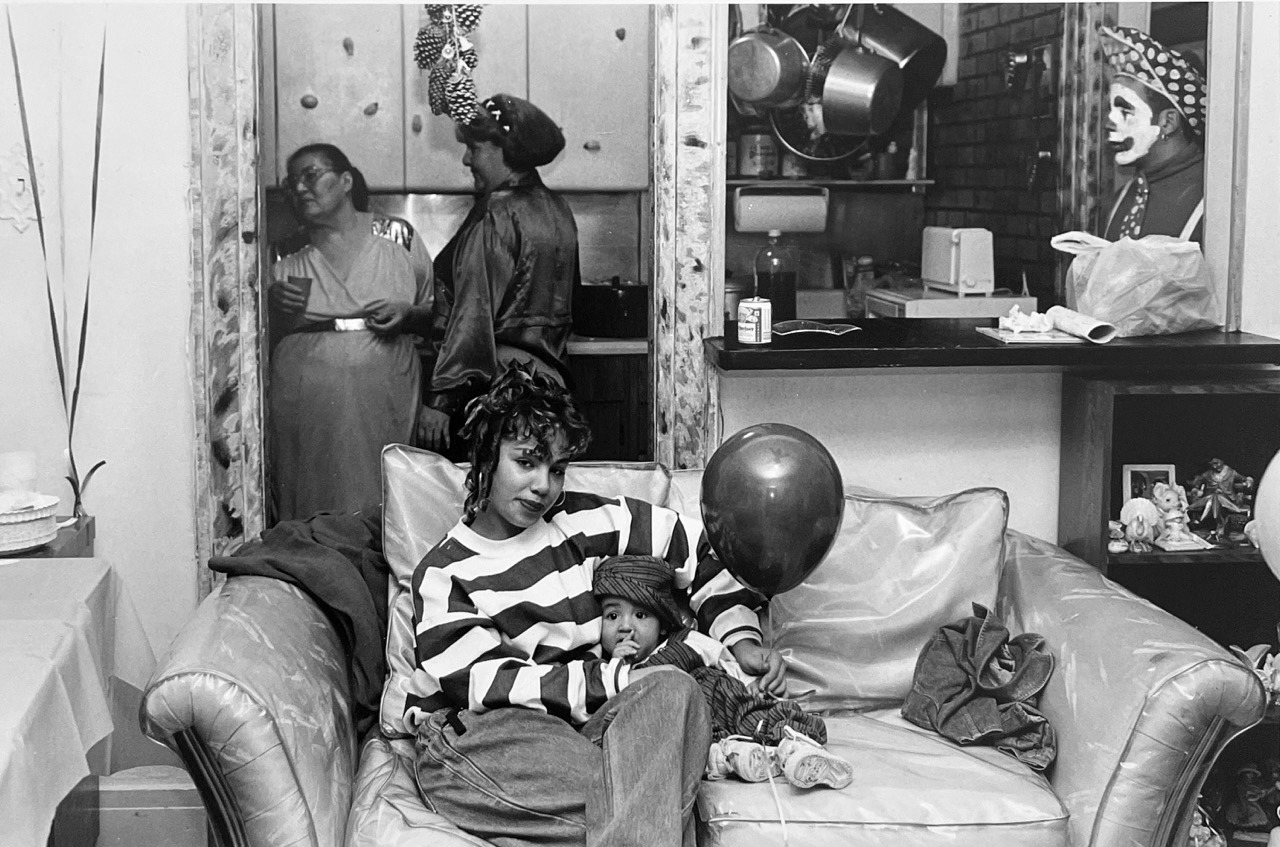
Nona Faustine’s pioneering portraits of young mothers in 1990s New York
In the early 1990s, Nona photographed Times Square during an era when it was one of the top destinations for teen runaways — overrun with them, really. It was also seen as the seedy capital of the world, a monumental red-light district, and it was kind of a street photographer’s buffet.
Nona habitually documented the area, but don’t ask me where these photos are now. They were good, even if they were on the grainy side, a style she purposely chose to match the grittiness of the neighbourhood.
She was a student of human nature, so teen runaways as her subject and Times Square as her backdrop fit her curiosity. But she couldn’t sustain it. Although she was a born and raised New York City chick, had grown up in the city’s “crack era”, survived junior high in Brooklyn, was street smart, knew how to fight and knew how to take care of herself, Nona was a sensitive soul. She wasn’t someone who could sustain documenting that side of street life.
It was easy for her to get to know the street kids she photographed because they were of the same demographic, young people who hung out all over the city, especially the East Village and Greenwich Village. But I think Nona felt a despair documenting them that definitely showed up in the photos, and she didn’t like it. She didn’t like not having hope for people so young. She was an optimistic person, not by nature but by will. Optimism was a choice for her. Her series Young Mothers (1992-94) was born from that choice. Nona wanted to capture hope rather than devastation.
All the mothers in the series were women that she knew: our cousin Joi; Nona’s friend and college classmate Mary Faith; Ebony and Carmen Jr were daughters of our mother’s co-workers; my friends Tanisha, Sabrina and Renee. All of them, except Mary Faith and Renee, Nona had known in their girlhood. Now, at the beginning of adulthood, straight out of the gate they were responsible for the most precious thing in the world, new life. And Nona felt that her job, first and foremost, was to show their beauty and humanity in a world that wanted to strip them of that dignity.
The Center for Photography at Woodstock is currently showing the first ever retrospective of Nona’s work. The photos in the show from the Young Mothers series give you a glimpse into the life of Ebony, whose portrait shows her stoically looking into the camera, sun shining on her face, pregnant belly proudly on display. She seems ready and unafraid of her future. We see Carmen Jr framed with her family. She sits proud in her motherhood, cuddling her son with a Mona Lisa smile on her face. Repeatedly in the series, we see scenes touched with love: Joi’s mother doing her hair, Tanisha and her son at bath time, and Renee captured in a pose with her son that will forever depict her as royalty. This photo is my favorite of the series. It is one of the many moments when Nona’s photography takes on a worshipful view.
In creating Young Mothers, Nona brings you into the lives of young women who are simultaneously on the precipice of adulthood and fully in it. She documents with reverence their pregnancies, their children’s births, new apartments, first birthdays, scenes of life with their partners, applying for government assistance, moments of exhaustion and moments of peace.
The photographs require you to see their whole life, their whole personhood. They were not shot as a cautionary tale, because Nona knew that this could become any young woman’s life, including hers. At the time she made the series, the way young women having babies were portrayed was that they were promiscuous or unintelligent beings who had made mistakes that they were forced to live with. Some people thought they were both. But Nona depicts them with respect, because these women embody a life where, even if their pregnancies weren’t planned, they chose for themselves.
Nona spent two of her undergraduate years at New York’s School of Visual Arts making this series. It was her senior project and she printed it herself. The work garnered acclaim among her professors and peers. Before she went on to make her most famous series, White Shoes (2012-21) — in which she visited sites across New York City that are linked to slavery and posed in each, often naked or almost naked, wearing white high heels — Young Mothers was her magnum opus. But when she snagged an interview with Vibe magazine to show them the work, they were very uninterested. This wasn’t the only event that made her put her camera on the shelf for several years, but it was a leading one. She packed the Young Mothers series away and hardly told anyone about it. It was a great body of work that Nona wanted to see made into a book, and not many saw it or knew of it.
Last year, a little after Nona’s passing, I said to her friend, the photographer Justine Kurland, “You know, Nona started out as a street photographer,” and she replied, “Almost everyone does.” For me, it is fitting that echoes of Young Mothers led Nona to Mitochondria (2008-16), a series of portraits of her mother, her daughter and herself, which created a path for White Shoes. But the genesis of these series is all held in that experience of photographing Times Square.