
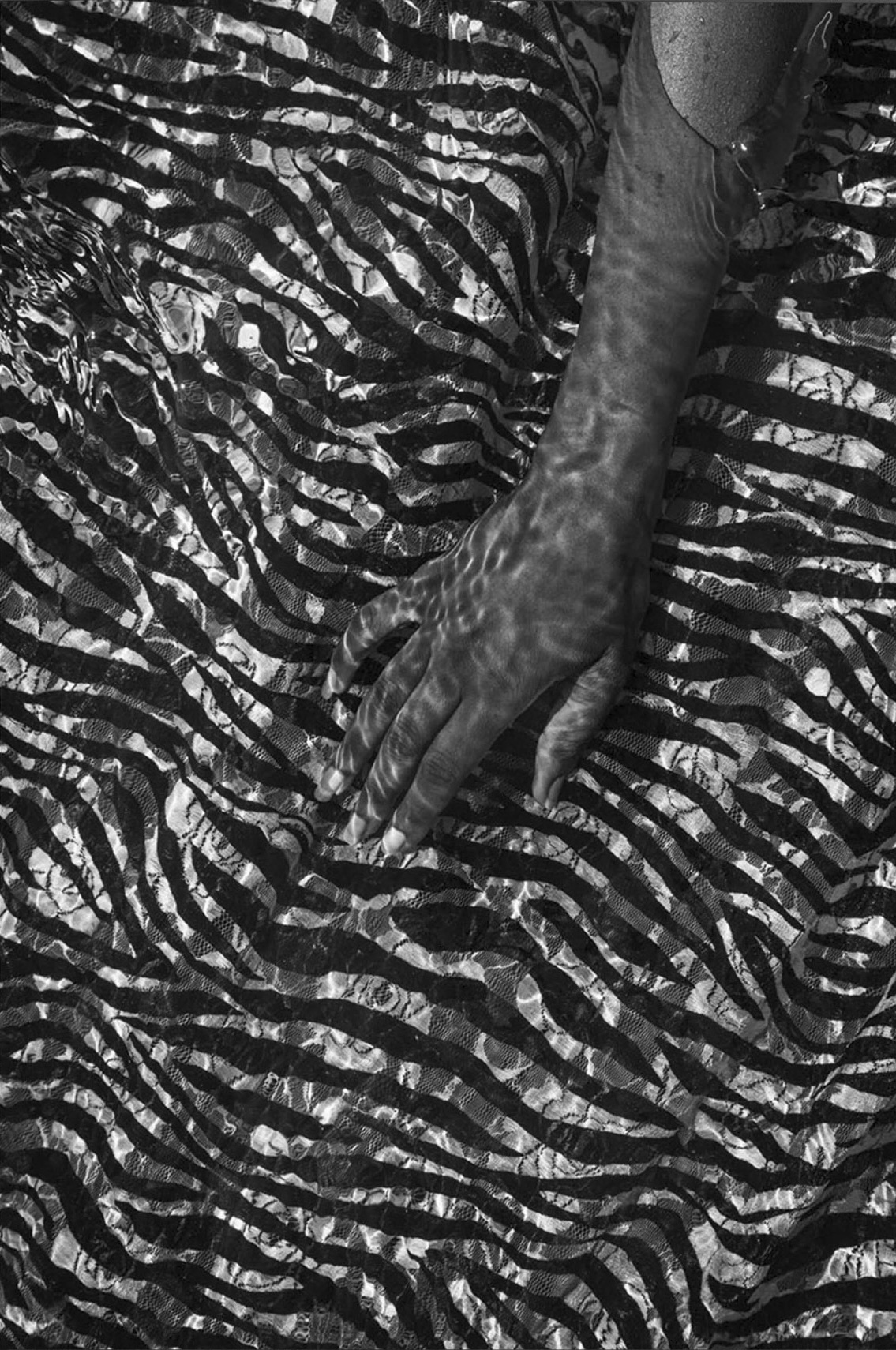
Keisha Scarville reflects on photography as ritual, the material afterlives of grief, and transforming the Brooklyn Museum into a space where personal remembrance becomes a shared act of belonging.
In ‘Where Salt Meets Black Water’, Keisha Scarville expands the intimate language of photography into a monumental public installation that honours memory as something lived, inhabited, and continually remade. Installed across the Brooklyn Museum’s plaza, the work draws on family photographs, her late mother’s garments, and the symbolic landscapes of Guyana to explore grief, migration, and the emotional geographies of the Caribbean diaspora. Rather than presenting memory as a fixed archive, Scarville invites viewers into a space where absence becomes presence, private histories resonate collectively, and movement through the work becomes an act of reflection. In this conversation, the artist discusses photography’s capacity to hold what cannot be seen, the evolving meaning of inherited objects, and how the spaces between countries, generations, and identities can become sites of healing and belonging.
‘Where Salt Meets Black Water’ transforms the Brooklyn Museum’s plaza into a site of remembrance and gathering. How did you create an installation that extends photography’s intimacy into a shared public space?
Keisha Scarville: This was the biggest challenge for me. How can a photograph created for the sake of personal remembrance be translated into a large public space? The façade of the Brooklyn Museum serves multiple purposes: recreation, rest, connection, reflection, and simply as a place to inhabit. I reflected on how individuals might happen upon the images, the potential for viewers to become enveloped by them, and how people would navigate the space. Rather than displaying all the images in their entirety, I focused on details from certain photographs for the museum steps and chose to enlarge some images more than others. My intention was for the installation to allow viewers to move in and out of the work, so that from any position, they experience something distinct or feel immersed within the image.
The exhibition is deeply rooted in your family’s Guyanese heritage while speaking to broader histories of migration across the Caribbean diaspora. How do you balance personal memory and collective recognition?
I am not certain that I am balancing both. Documenting my family’s story has been of great importance. For me, the collective identity of the Caribbean diaspora is shaped by the individuals and families who have migrated elsewhere. While my family’s narrative is deeply personal and rooted in Guyana, there are numerous overlaps with the broader story of the Caribbean diaspora. Commonalities often emerge in the reasons for migration, the experiences and transitions encountered, and the hopes and histories carried by those who leave. These voices resonate throughout the region, collectively shaping the Caribbean experience.
Garments belonging to your late mother continue to occupy a central place in your work. Over time, how has your relationship to these objects changed, and what have they taught you about memory as a living, evolving process?
Incorporating my mother’s clothes into my images marked a significant shift in my relationship to photography. This process began with a strong desire to evoke her presence in an image in the wake of her passing. It prompted me to explore alternative ways of seeing and constructing spaces. Over time, I came to view my mother’s clothes as material archives. As I have continued to process my grief, my understanding of these materials has evolved. The clothes have transformed from remnants of my mother that I could hold onto into objects that also contain a part of myself. Archives are not static; they carry histories and also hold the residue of those who engage with them.
The title ‘Where Salt Meets Black Water’ evokes both geographical landscapes and emotional states, while referencing the healing black waters of Guyana. What drew you to this metaphor, and how does it shape viewers’ encounter with the installation?
I wanted the title to evoke a space between lands, specifically between the United States and Guyana. The expanse of the ocean and these unique waters of Guyana became metaphors for thresholds. For me, these waters represent a meeting place where grief can be encountered, and healing can begin within that liminal space. The title also reflects my experiences as a first-generation American. Within the installation, I intentionally abstract details and gestures in my images to represent the indefinable area between Guyana and the United States. I found that the museum’s facade was well suited to this installation, as the space feels like a public pocket that is neither entirely the street nor fully inside the museum.
Photography, a medium traditionally associated with preserving presence, often explores absence in your practice. What interests you about the tension between what an image reveals and what it can never fully recover?
For a long time, I understood photography as a medium for direct representation, the proverbial “mirror with a memory.” After my mother’s passing, I became increasingly interested in the potential of photographs to convey what is not immediately visible. I began to question how an image can serve as an index of emotions or embody the paradox of objects that stand in for the absent body. I am drawn to exploring what is elusive in photography, as it introduces a new language of looking for me.
By bringing together photography, textiles, and architecture, the installation invites audiences to inhabit memory rather than simply observe it. How important are physical movement and embodied experience to how you want this work understood?
The installation is activated through both movement around the space and moments of stillness, but it must be entered. I would like viewers to approach it with curiosity.
Throughout your work, ordinary family photographs and personal belongings serve as vessels for broader conversations about migration, identity, and loss. What do you hope visitors carry with them after encountering ‘Where Salt Meets Black Water’, especially when questions of displacement and belonging remain so urgent?
This installation serves as a tribute to my parents and to the broader Caribbean diaspora community in Brooklyn. I hope visitors reflect on their own experiences with the themes of the installation, particularly loss, inhabiting the in-between, and what is carried forward. Many of us continue to exist in that in-between space, searching for belonging and carrying home inside us.
This exhibition is on view at the Brooklyn Museum until 4 October 2026.