
300 Ways to See a Father: Keisha Scarville’s Passports
The artist interrogates narratives of citizenship and migration in a series inspired by her father’s earliest passport photo
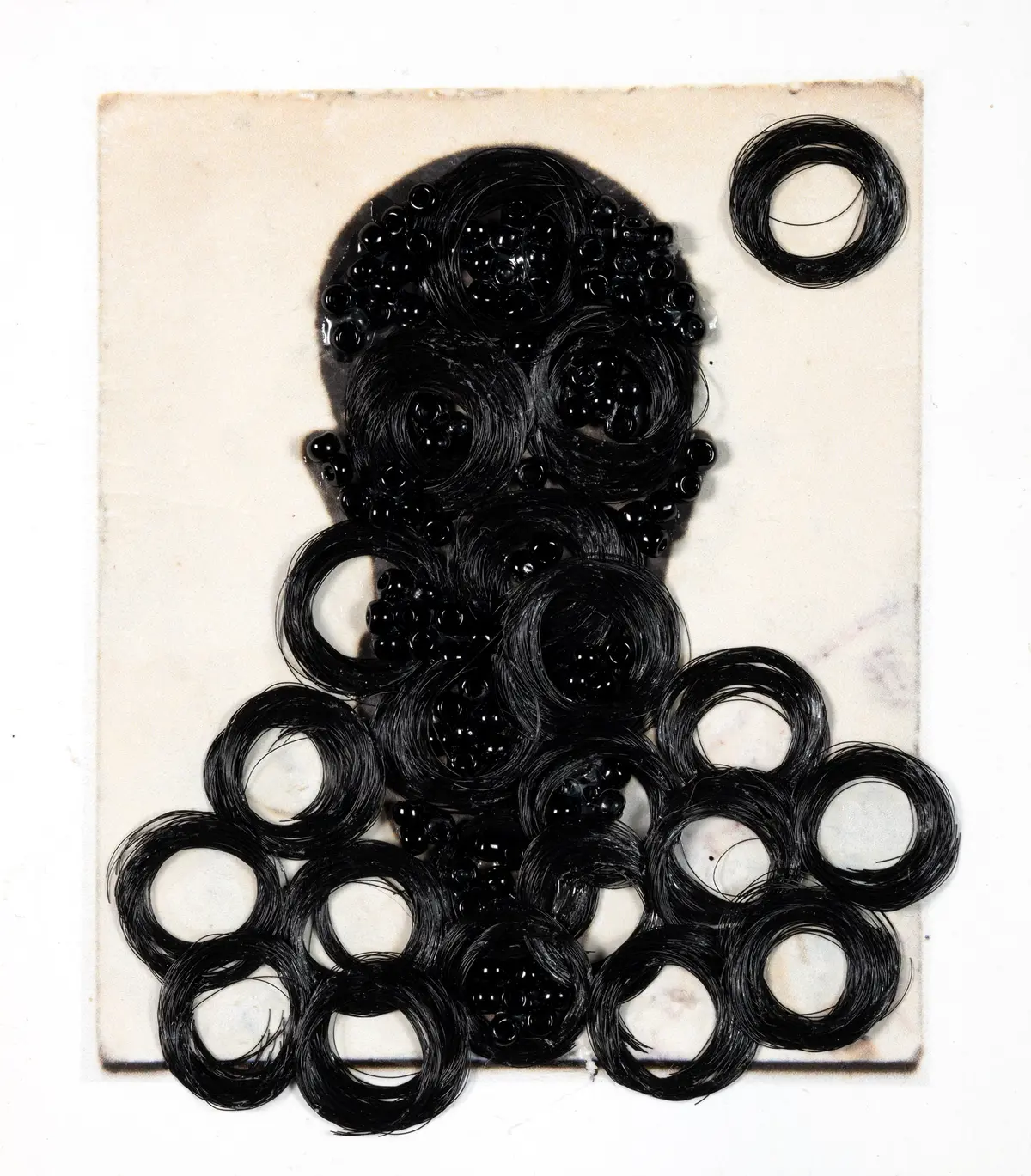
A young man peers out from a diminutive frame, only 2 x 2, small enough to hold in the palm of one’s hand. In the medium’s expected fashion, he looks directly at us, his expression sober. Under the gaze of his attentive daughter, this young man transforms. A shock of red on the lips, a halo of orange, yellow, and blue around his head. He is adorned in beads and pearls, utterly resplendent. Figures bloom from his chest. At times he is spectral, more spirit than man, and often he is genderless. The phrase “little boy” obscures his eyes, reminding us to be careful with his image. He is a superhero or a god, and always a muse.
These images are contained in Passports, a series of over 300 works by photographer Keisha Scarville, in which the artist reconfigures her father’s earliest passport photograph. On 11 June, MACK will release a monograph of the series, Scarville’s second with the publisher.
Scarville was in her early twenties when she first received the photograph from her father, who gave her a stack of images while he was moving and clearing out his belongings. “I’m always fascinated by seeing images of my parents when they were far removed from being my parents,” says Scarville. She framed the image and placed it on her dresser, where it sat untouched until 2012. Scarville’s father, who emigrated from Guyana to the United States in 1967, was retiring and approaching his 50th year in the country. Scarville removed the photograph from the frame and began to ponder it more deeply.
“The first iteration of the series was a collage,” says Scarville. She flipped through magazines, looking for “images of other Black and brown people to “infuse the passport photo with [a] multiplicity,” she explains. Working with her father’s image soon became a ritualistic, daily practice. “I started having periodic conversations with my father,” Scarville says. “We would have these early morning conversations, and after I would immediately go back and think about ways to create something with the image.”
A sense of curiosity, care, and devotion emanates from each version of her father’s passport photograph. These resplendent images bring to mind Simone Weil’s proclamation that “attention, taken to its highest degree, is the same thing as prayer.” In Scarville’s deft hands, the passport photo – a state-sanctioned image that reduces and flattens identity in order to validate one’s ability to move freely through space – transforms into a defiant reclamation of her father’s complexity. His is kaleidoscopic and unwieldy. Like all immigrants, he is a shapeshifter, an alien, for how else do you describe an existence in which you arrive at a place that cannot understand you, and that you cannot understand?
Scarville initially thought about the passport photo as a “signifier of who a person is,” she explains. Over time, her relationship to its function changed. “Initially, it was a way of making a statement, and now it’s a space of investigation. There’s this question of citizenship that is being brought to the forefront. Who is and who is not [a citizen], and what that looks like.”
At times Scarville writes directly on her father’s image, excerpts from works by authors Ben Okri and Jan Carew. In one, lines from Okri’s poem Lament of the Images surround Scarville’s father, his face whited out and dotted with black circles: “And when the Images began / To speak / In forgotten tongues / Of death / The artists of the alien / Land / Twisted the pain / Of their speech / And created a new / Chemistry / Which, purified of ritual / Dread, / They called / Art.” Scarville removes “Art,” a subtle intervention. In the word’s absence, the image becomes a testament to the tenacity, ingenuity, and resilience inherent to immigrant experience, a self-fashioning that constitutes its own form of art.
When the opportunity came to create a monograph of Passports, Scarville was initially apprehensive. “It felt too daunting,” she says. She focused on what would become her first publication, lick of tongue, rub of finger, on soft wound, whose tactile and elliptical visual language recalls the one found in Passports. “I started doing a lot of research into footage of Guyana around the time my father left, and New York City around the late 60s and 70s,” Scarville says. “I was thinking of the social landscape of America, my dad leaving the Caribbean, the process of Guyana coming to this place of independence in 1966, and what that entailed and required in terms of liberation and resistance.”
In Passports, Scarville melds the personal and political, social and historical. Included are excerpts of conversations between Scarville and her father, photographs taken in Guyana, and archival images. In one of the passport photographs, Scarville overlays her father’s image with that of Tommie Smith and John Carlos at the medal ceremony for the 1968 Olympics, their raised fists in black gloves, in a salute to Black power. Scarville covers their faces with gold glitter, which cascades from their bodies onto her father’s ears, chin and chest.
“I started thinking about moments of resistance and claiming power, particularly Black power,” says Scarville. “I wanted to have my dad’s arrival and this iconic photographic moment overlap with each other. And gold, being such an auspicious element in Guyana, is something I go back to a lot in the work.” Gold – in the form of paint, leafing, and glitter – appears throughout, as well as the colours red, black and green, an homage to the Pan-African flag created by Jamaican political activist Marcus Garvey, who Scarville’s parents were acolytes of. “We had a huge poster of Marcus Garvey in our apartment growing up, and I wanted to infuse some of that thinking and visual representation.”
As with Scarville’s practice at large, Passports reconfigures our understanding of a photograph’s function and purpose. Embedded in the language of photography is the idea of capture, a notion Scarville seeks to disrupt. “There’s so much about Passports that is about release,” says Scarville. “What is released from the photograph? What aspects are present, but not visible?” Her use of juxtaposition, layering and collage collapses time and space, drawing the viewer into a space of transition. We hover between life and death, presence and absence, appearance and disappearance.
When I ask Scarville if the series has ended, she assures me it’s ongoing. “There was never a moment where there was a desire to close the door. I let go of thinking about it having an end point or closure.” For Scarville, there’s a sense of “opacity” she feels around the work. “Over time, I have been continuously pulling back layers. A couple of days ago, I was working on a new piece and there was something I noticed in the image that I never saw before, and I’ve been looking at it every day.”
Passports includes an exchange in which Scarville asks her father how he’s changed since he’s been in the United States. “You don’t know what your father went through,” he responds wryly, after a long pause and laughter. Passports pulses with Scarville’s desire to understand, to reclaim and find, as Ben Okri writes, “a new language of mixed tongues / that only archives can utter.”