
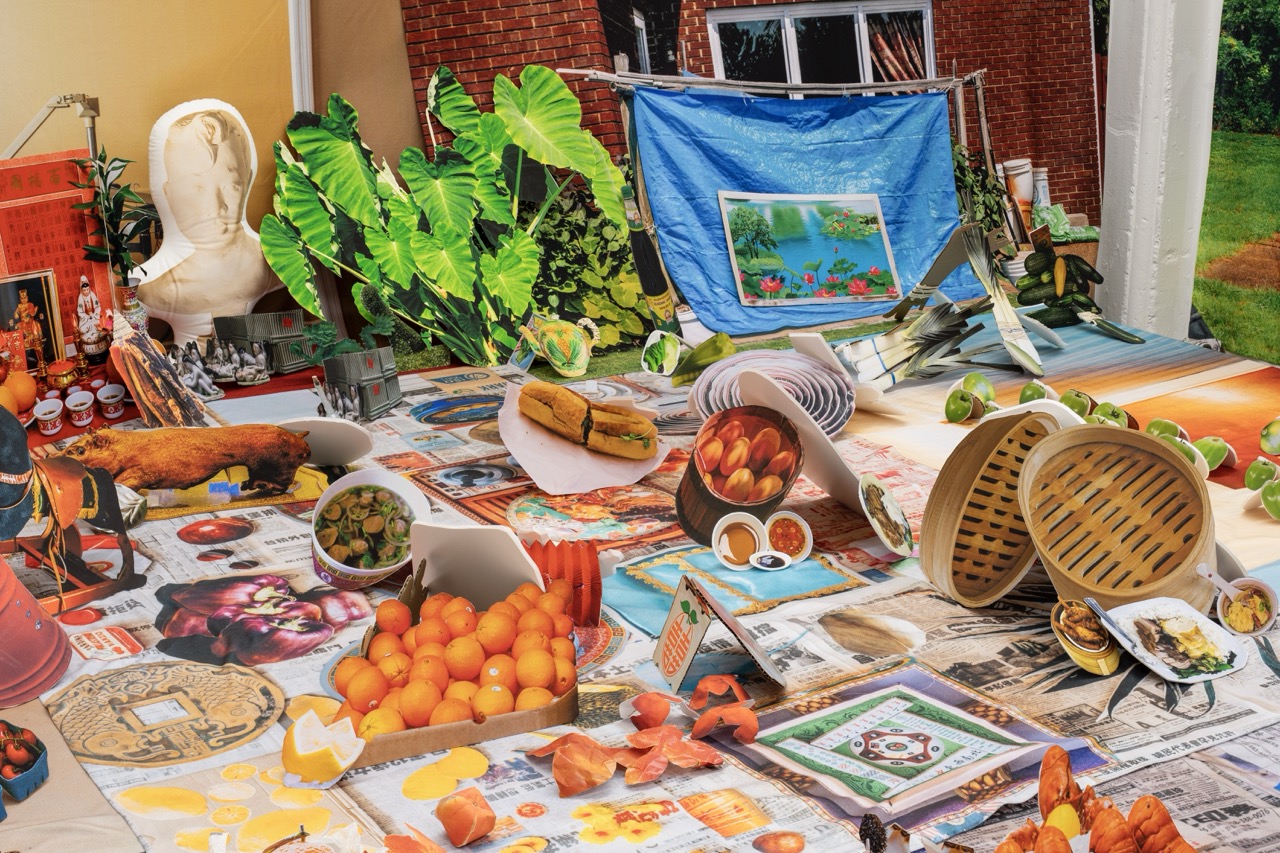
In a 2023 interview with the New York Times, photographer Tommy Kha described his recent visits home to Memphis to visit his mother May:
“[Now] when he heads home, [Kha and his mother] fall into a rhythm. She asks whether he’s hungry. She asks if they should eat first before they make pictures. And she asks if he has any ideas for the pictures.”[1]
May––a constant figure in Kha’s vivid, autobiographical images that explore the cultural hybridity the artist experienced growing up in Memphis in a Vietnamese-Chinese household–– is not so different from any other maternal figure in the South. Love is shown, not through emotion, but acts of service and care, and “have you eaten?” is as good as “I love you.”
A feast for the senses that consists solely of a single dioramic installation work, Kha’s exhibition Leftovers at Brooklyn’s Higher Pictures explores the dynamics of the family gathering. Brightly colored fruits and vegetables––oranges arranged on a silver platter, comically large leeks, and granny smith apples––are set out on a raised platform surrounded by large-scale photographs printed on fabric and haphazardly hung around the gallery. Prepared dishes from Eastern and Western food traditions, and a selection of household trinkets, complete the bounty.
Yet, Kha’s almost Dionysian spread is not for human consumption. All of the objects––the food, kitchen supplies, and trinkets––are photographs affixed to recycled cardboard backing, arranged and propped up as if they were set dressing. The most known reference to this illusion is the cutout of Royal Dansk Danish Butter Cookies with their instantly recognizable blue tin––the ones in our grandmothers’ kitchens that, much to our collective childhood disappointment, were storage for knickknacks rather than sweets.
Based on these cardboard objects alone, the scene is celebratory yet ambiguous. Kha’s fabric-printed photographs, though, tell a different story. Hanging at the forefront of the installation is a photograph of a matriarchal figure––presumably May––in the kitchen of an unfinished home. This matriarch stands defiantly in front of a propane cooktop, the only appliance in the room, as Kha lurks from behind the burners. Though obscured by other wall hangings and cardboard cutouts, the viewer’s gaze is eventually guided towards the center image of the installation. Here, Kha stands bloodied and bandaged in front of an open casket with the traditional Western funerary accoutrements of white flower bouquets and a portrait of the deceased.
Once death enters the picture, the context of the installation changes. What could have been interpreted as joyful abundance turns to a scene of mourning––not a cookout, but a wake. Other elements of Leftovers snap into sharp focus, such as the photographs of empty restaurants and rooms and images of family altars are placed along the wall. In the exhibition text for Leftovers, Kha notes that he was inspired by the Asian folkloric practice of burning joss paper. An act of veneration for the deceased, people will burn paper models of objects––from money to more worldly delights such as jewelry, cigarettes, and cars––as offerings to their ancestors to guarantee their comfort in the afterlife. With its bountiful facsimiles of food and familial comfort, Leftovers is an offering to be burned––a symbolic feast for the dead and an act of care that transcends the bounds of culture and one’s worldly presence.